What clever new ways of teaching are being employed by our schools to keep education relevant and engaging in a fast-paced world? Charlotte Phillips finds out
Words by Charlotte Phillips
Throughout history, educators have always innovated – often being greeted with suspicion. Was adding maths and dangerously faddy sciences to the 19th-century curriculum essential when Latin and Greek were surely all a well-educated child needed to know? In the mid 1800s, did girls honestly have to get their own schools, rushing around playing team sports like their brothers and even – crikey – enjoying themselves at the same time?
With the answer to those questions being a resounding ‘yes’, the educational offerings of schools have continued to evolve in response to societal and, increasingly, technological change. While predicting the future may not be an exact science, teachers in our area’s schools are impressively clued up about what lies behind the changes they’re making – and why they’re important.
Harnessing technology
Some of the schools’ innovations sound excitingly futuristic. At Kimbolton, for example, technology is transforming the way pupils work and learn – and they absolutely love it. Well, who wouldn’t, when you’re asked to design your own creature and your written description can be instantly visualised by an online image creator – giving you the chance to see just how well your described creature matches the picture in your mind’s eye?

The Perse both cultivate collaboration
As Andrew Bull, teaching, learning and innovation lead at the prep school, explains, it’s a way to show children how an idea that seems completely real in their imagination could need further work before it becomes just as vivid to others. “As a teacher, I’m always saying to children that they need to explain their ideas further,” he says. “They always have that creativity – it’s more about getting it out of them.”
When they see that the image of their creation is, say, missing the odd eye, ear or limb, they want to improve it and get it right. “They want to edit their work and add more to it – not because I’ve told them to, but because they have more ownership.”
Once they’re happy with the description, the final stage is physically creating their character using a 3D printer. “They get to hold their character in their hands, and the potential for that is mind-blowing,” continues Andrew, who admits to being just as excited as his pupils are about the whole process.
As he points out, the process is built on AI and the impact is entirely positive. “We see AI enhancing our teaching and improving the learning of our students. It enables that whole journey of creation: from writing on paper to seeing it visually, and then holding it in real life.”
Removing barriers
Using these clever new ways of teaching to enhance more traditional approaches is well understood at Gresham’s, whose Dyson Building builds connections and collaboration between STEAM subjects – science, technology, engineering, arts and mathematics. While some of the ways technology is used are visually captivating, including screens with projected images for drama productions and maths classrooms covered in floor-to-ceiling equations, much of the work that goes on is about making the learning experience an increasingly effective one that removes barriers, allows faster feedback and makes it far easier to share information and collaborate.
For Darrell Chart-Boyles, deputy head of academic at Gresham’s, an English lesson where pupils have to annotate a poem might sound relatively routine, but thanks to a nifty bit of software – in this case Microsoft One Note – it’s anything but, allowing pupils to work interactively and show their work to the rest of the class.
“The pupils like this way of working and it’s something they’re keen to show off,” he says. “We can share resources directly with their devices, either in or ahead of lessons. They’re annotating the poem in class. Before this, sharing a piece of writing would have been hard, but now they can ping their screens straight on to the whiteboards and we can all see their work and celebrate it.”
Gresham’s disrupts the narrative that young people must choose between science and the arts
Making it so easy to share work and resources and get feedback has, he says, broken down barriers and made everything much faster, as well as changing the way he teaches. “I now teach from the back of the classroom more and can see what they’re doing on their screens, so it’s changed the classroom environment as well.”
Other benefits include real-time marking. After all, why wait until later when the teacher can both see and comment on a student’s work during the lesson? “I can be literally marking their work from my device as they’re writing. I don’t need to wait until they hand in their books at the end of the lesson, but can add my annotations in the margins as they’re working. I think those kinds of things are brilliant,” says Darrell.
Gresham’s also makes extensive use of Microsoft Teams to set homework online, complete with deadlines and links to extra resources. “Before, as an English teacher, I would have had to photocopy extracts and readings – now I share them electronically, which is huge,” he adds.
As he stresses, clever use of technology can make interactions between pupils and staff speedier and more effective. “We work hard to teach the children how best to use their devices and what they’re most useful for, as well as having that personal connection with them.”
Adapt to survive
Building connections with individual pupils and offering a more personalised approach is another focus for schools in our area. Take St Mary’s School, where adaptive teaching involves setting the same goal for every pupil, but then helping them achieve it with appropriate levels of challenge and support, tailored to the individual students along the way.

At The Perse, expeditions teach transferrable skills
“We adapt our teaching in the moment to the various strengths and needs of our students,” explains senior teacher Andrew Abery. “This approach stretches and supports the individual needs of the highest academic achievers and students with a range of special educational needs alike, using direct questioning, modelling or prompts.” This is deployed with other strategies, like giving groups complex problems to solve – each student assigned a specific role in finding the answer – which promotes collaboration. This has “enabled more confident learning and less reliance on the teacher, developing independent learning and academic rigour.”
And while it’s easy to assume that most transformative aspects of education are classroom-based, that’s far from the case.
Ben Parker, director of outdoor education at The Perse, is an impressive advocate for all the skills that the school’s ambitious programmes can deliver.
Of course, that’s not the only reason around 800 pupils sign up for the Perse Exploration Society (PES), given the amazing true-life adventures they get to experience, starting with local trips in year 7 and potentially culminating in a three-week trip to the Himalayas for year 12.
Along the way, the programme also zeros in on transferrable skills that are like catnip for prospective employers. “We’re putting them in situations where they’re working without mobile phones, encouraged to work with and look after one another and socialise for long periods of time without being able to retreat from those situations,” Ben explains.
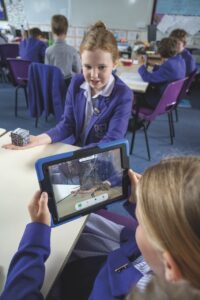
Kimbolton is employing augmented reality in lessons, a trend that’s increasingly popular for creating a more immersive, interactive experience. Image by Matthew Power Photography
“We give the pupils basic skills in food hygiene, communications, problem-solving, teamwork and leadership, then present them with gradually more extreme settings in which to apply them.”
Get something wrong and – unlike in almost any other area of school life – the impact can be serious and very real. “A lot of learning in the classroom does have a theoretical impact,” says Ben.
“Ultimately, when you’re working in an outdoor setting, if you make food and do it badly, for example, it will cause other people to have a bad experience.
“If you don’t make the right decision there, you could find yourself in a difficult situation out on an expedition and put yourself in danger. So, there are real-world consequences to your actions.”
What comes across from schools in our area is just how much thought is going into planning for the future, with initiatives that fuse clever new ways of delivering education with older and highly effective techniques, in and out of the classroom.
Getting it right means giving their pupils the best chance of a successful future. “We want to make sure that our pupils can differentiate themselves in the workplace,” adds Ben.
“One of the realities of AI is that, ultimately, many jobs won’t be necessary. We’re trying to make students stand out, providing not just the academic but the transferrable skills that will make them better equipped later on.”
