

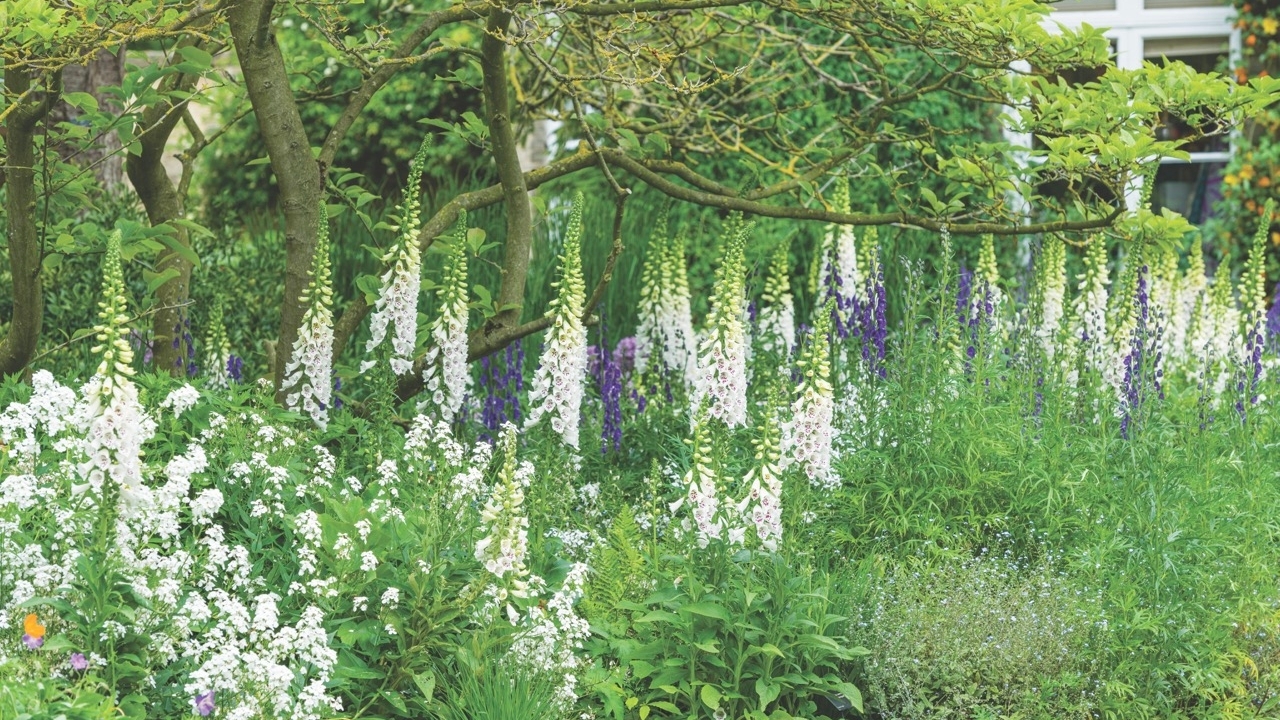
Not only can native plants add colour and interest to your garden throughout the year, they also support a rich diversity of wildlife, says Sally Petitt
Images: Howard Rice
Across the UK, around 1,700 native plant species weave a rich and familiar tapestry across our landscape.
You only need to cast an eye over the countryside to spot a host of well-loved native plants. From hedgerows of dog rose (Rosa canina), hawthorn (Crataegus monogyna), blackthorn (Prunus spinosa) and common dogwood (Cornus sanguinea), to woodlands adorned with common beech (Fagus sylvatica) and sturdy English oak trees (Quercus robur) that tower above carpets of perennials like bluebells (Hyacinthoides non-scripta), wood anemone (Anemone nemorosa) and dog’s mercury (Mercurialis perennis).
In summer, pops of colour appear with arable weeds such as cornflower (Centaurea cyanus), corncockle (Agrostemma githago) and field poppy (Papaver rhoeas), creating midsummer vibrancy in meadows. Chalk grasslands provide a habitat for bee orchids (Ophrys apifera), cowslips (Primula veris), viper’s bugloss (Echium vulgare) and the Cambridgeshire county flower, the pasque flower (Pulsatilla vulgaris).
Less discerning natives like brambles (Rubus fruticosus) and stinging nettles (Urtica dioica) – both great for wildlife – adapt to many habitats, such as wasteland, scrub, woodland and hedgerows. Together, they tell the story of a flora that is both resilient and deeply rooted in our everyday surroundings.
What is a native plant?
Native plants are those that have evolved naturally in a habitat over thousands of years, rather than being introduced by man. In the UK, a plant is generally considered native if it arrived and established without human introduction, typically after the last glaciation (around 11,700 years ago).
These plants have adapted to local soil, aspect, climate, fauna and flora. They are essential in providing food, protection and breeding habitats for insects, birds and mammals, and also help maintain soil health and water quality as well as ecological stability.
While many are familiar to us, appearing in vast numbers throughout the UK, others occur in small numbers in isolated populations and niche habitats. In 2025, the Botanical Society of Britain and Ireland listed 434 of the 1,720 native plant species as threatened.


How can gardeners help?
Native plants needn’t be limited to their natural range, and often make charming additions to our gardens. They also help support the ecosystem by providing a food source for large mammals, birds and pollinators, as well as a habitat for sheltering wildlife.
While the familiar nettle may not be at the top of every gardener’s desired plant list, it provides a valuable food source to more than 100 invertebrates, including red admiral and comma butterflies, and garden tiger and buff ermine moths that feed on the nectar. The caterpillars of these invertebrates may also feed on the leaves of the stinging nettle, and birds such as reed buntings and siskins eat the seeds.
There are many more attractive native plants that can easily be grown at home. Scarlet poppies and sky-blue cornflowers can be added to the garden by sprinkling seed in autumn or winter, to produce a vibrant splash of colour in summer. Primroses (Primula vulgaris) and cowslips can be added to a sunny border or lawn to provide spring colour.
Some, such as the pasque flower, are more discerning, requiring chalky soils and an open site. Foxgloves (Digitalis purpurea), wood anemone and creeping bugle (Ajuga reptans) will happily grow in shady gardens.
English yew (Taxus baccata) is a great choice for a formal, evergreen hedge. If you have space for a sprawling boundary treatment, a mixed native hedge of plants such as dog rose, field maple (Acer campestre), hazel (Corylus avellana), spindle (Euonymus europaeus) and honeysuckle (Lonicera periclymenum) can provide year-round horticultural interest, bearing a succession of flowers through spring and summer, and fruit through autumn and winter. This has the added bonus of providing food and shelter to a host of native invertebrates, mammals and birds all year round.
If you have the luxury of even more space, you might select an English oak, which is known to support 2,300 species of large mammals, birds, bats, beetles, ants, butterflies, moths, fungus, lichen, liverworts and mosses.


Mutual benefit
Here at the Botanic Garden, we grow approximately 8,000 species of plants from across the world, including a large number of native species – both common and threatened. Highlights include drifts of delicate cow parsley (Anthriscus sylvestris), the aquatic bogbean (Menyanthes trifoliata), bird cherry (Prunus padus) and a personal favourite, devil’s-bit scabious (Succisa pratensis). Not only do these add to our floral displays, but they also contribute to the biodiversity of the Botanic Garden.
While domestic gardeners may not be able to emulate a spring display of naturalised bluebells or cowslips on a large scale, many native species can be easily included in our gardens. The key to growing them is ensuring that the conditions in your garden replicate the habitat in which native species grow.
By adding native plants, our gardens become more than just attractive spaces – they become living, breathing parts of the wider landscape, quietly supporting the wildlife that depends on them.
Gardening jobs for June
1. Plant out the last of your tender perennials and annuals once the risk of frost has gone.
2. Hoe beds and borders to keep weeds in check.
3. Water new plantings to ensure that they establish well, but use water wisely.
4. Cut back dead flower heads and foliage to encourage later flowering.